• Skip to primary navigation
  • Skip to main content
  • Skip to primary sidebar
  • Skip to footer

Dr Sarah Buckley

  • Home
  • Books
    • Book Reviews
  • Articles
    • Attachment Parenting: An Introduction
    • Pain in Labour: Your hormones are your helpers
    • Epidurals: risks and concerns for mother and baby
    • Ultrasound Scans- Cause for Concern
    • Leaving Well Alone: A Natural Approach to the Third Stage of labour
    • Getting a Good Night’s Sleep: Another Perspective
    • Mothering, Mindfulness and a Baby’s Bottom: An Introduction to Elimination Communication
    • Ten tips for safe sleeping
    • Lotus birth – a Ritual for our Times
    • Giving Birth at Home
    • Healing Birth, Healing the Earth
    • Maia’s Birth- a family celebration
  • Blog
  • About Sarah
    • More of Sarah
    • Sarah’s Schedule
    • Frequently Asked Questions
    • Contact Dr Buckley
  • Shop
  • Sign up to Sarah’s Newsletter

Blog

The Best Possible Start: Resources for Expectant Parents

June 28, 2018 by Sarah Buckley

We have had the pleasure of welcoming 3 new nephews into our extended family in recent months.

Congratulations to Alex and Dan, William and Temah, and Kate and Chris (pictured with Max) on your bonnie firstborn boys!

We all want our loved ones to have the best possible start to family, and obviously to make their own informed choices.

How can we support expectant family and friends—including friends of friends and work colleagues– in this situation?

Well, luckily there are some great resources for any parents-to-be.

Check out my podcast interviews too and some other great online resources.

First up, for gentle birth choices, I always send expectant friends and loved ones a copy of my book Gentle Birth, Gentle Mothering!gentle birth, gentle mothering. Sarah J. Buckley, MD

Parents-to-be appreciate the inspiration and support to trust our bodies, birth and babies, as I share my own experiences (including my long and winding breastfeeding career!) But GBGM is also full of the research that supports gentle birth and parenting choices, so that parents can follow their hearts and instincts, as the real experts in their bodies, babies and families. (For those ordering in Australia, I sign all copies and can usually personalise, if you include a note with your order.)

Another favourite resource is the amazing Happy Healthy Child DVD series, which covers pregnancy through to early parenting.  Beautifully filmed, it features experts from around the world (including myself) with a blend of science and wisdom designed to help parents eliminate fears and anxieties, avoid unnecessary and unwanted interventions, and feel confident and ready for this wonderful time. This great resource is now free  to watch!!

In relation to birth, I believe that a great DVD or video can go a long way to undo the cultural conditioning and images of birth as intrinsically frightening and dangerous. Among many lovely films, I recommend the paradigm-shifting film Orgasmic Birth (the Best Kept Secret!, with subtitles in Spanish, Portugese, French and German) and related resources, and the lovely Birth as we Know it, for the variety of experiences and environments, including home, hospital, and birth centre. Birth as we Know it is also available in German, Spanish, Italian, Polish and other languages, and the Dads are especially touching.

Wherever you are planning to give birth, the recent Born at Home film is a great introduction to the pros and cons of different birth choices. Beautiful footage of gentle natural births too!

Other films with a more political perspective, which can be a useful eye-opener for first-time parents, include The Business of Being Born (US) for it’s great (and true) storyline and the groundbreaking Australian film BirthTime.

For birthing books,  I recommend the wonderful Birthing with Confidence by childbirth educator and birth attendant Rhea Dempsey, who provides straightforward and wise information about navigating the maternity care system, and the importance of your birthing team. Also, check out Rhea’s second book Beyond the Birth Plan.

And you can support the birth team, including your partner with The Birth Partner by Penny Simkin, who founded the doula movement!

I also believe that sharing stories and experiences of birth that are realistic but generally positive is very valuable for parents-to-be. I love Ina May Gaskin’s classics Spiritual Midwifery (a bit hippy, but still a personal favourite!) and Ina May’s Guide to Childbirth

I also recommend the fabulous nutrition advice, from preconception to birth and baby in Real Food for Pregnancy: The Science and Wisdom of Optimal Prenatal Nutrition

In the early days, new mamas, babies, partners and families need lots of practical support–hopefully an available partner, mother, friend, or all of the above–and to know that it’s no shame to ask for help.

And it’s ideal to plan this time of rest and recovery, even before the birth, with support from books such as The Fourth Trimester: A Postpartum Guide to Healing Your Body, Balancing Your Emotions, and Restoring Your Vitality

Check out this fabulous Postpartum Planning Essentials online course from Dr Oscar Serrallach- a great ‘baby shower’ gift for expectant parents too. His book The Postpartum Depletion Cure is also highly recommended

Another favourite for postpartum mamas and others is the La Leche League’s  Sweet Sleep, which covers gentle approaches to sleeping and breastfeeding , with some great problem-solving resources.   For more about baby sleep, including safe co-sleeping, see the wonderful information from baby sleep researchers James McKenna (US) and Helen Ball (UK.)

And of course, there are enormous changes in our intimate partnerships with the arrival of a new baby, no matter how joyful! Becoming Us by relationship counsellor Elly Taylor  is a wonderful road-map for new parents.

In early parenting, I believe, like Jan Hunt, from the Natural Child project, that “The baby is the book” and that following our own baby’s  lead is generally better than following anyone else’s opinions, including our own!

Some very aligned and abundant online resources include  Raised Good

Our mothering (and fathering) instincts are fully supported by the care-taking hormones that we release as we carry, hold, breastfeed and sleep close to our babies. (And BTW these interactions can help us to close any “hormonal gaps” from birth or early contact.) More about this in Gentle Birth, Gentle Mothering!

I also believe that, as parents, we can have an easier time when we understand the importance of our biology and instincts, as well as  the cultural and political contexts of parenting.  When we see the huge variety in parenting practices globally and historically, it helps us meet our babies real biological needs with confidence.

One of my all-time favourite resources here is Parenting for a Peaceful World  by psychologist Robin Grille. You can get a taste of this profoundly important book–and of the impact of parenting on the planet– in this short video.

Other useful cross-cultural perspectives include the classic  Continuum Concept, which recounts the first encounters with a South American tribe, and their parenting practices that support wellbeing and lifelong happiness. This book has sparked a gentle parenting revolution!  Anthropologist Meredith Small’s Our Babies, Ourselves is another personal fave

For more resources about carrying your baby, see www.carryingmatters.co.uk

Special situations

If your loved ones have had a previous bad experience in birth, please direct them to this excellent resource:  How to Heal a Bad Birth 

For open-minded parents-to-be, the postpartum practice of Lotus Birth (non-severance of the cord) gives mothers, babies, fathers and families a restful and peaceful start. Also described in Placenta the Forgotten Chakra

Diaper Free (raising our babies without nappies/diapers) is another peaceful  practice that aligns with a gentle parenting- and its fun too! (Read my experiences here)

** Links are to author websites, Amazon US or Booktopia, with some affiliate links that help to fund this website. Please support your local bookstores too!

Filed Under: Blog

The New Prenatal Testing

April 18, 2018 by Sarah Buckley

Prenatal testing - Gentle Natural Birth

I was 35 when pregnant with my third baby, and 40 with my fourth.  This put my babies in the ‘high risk’ category for chromosomal problems including Down Syndrome. Should I undergo testing to find out if my baby was affected, involving procedures that would increase the chance of losing my baby? Or should my partner and I accept the small chance that our baby could be affected, with the knowledge that this would have a huge impact on our family and lives?

In the years since I faced those decisions for myself– you’ll have to read to the end to see what we chose–prenatal testing has become more simple and also more complex. It is simpler because the newest tests require just a blood test, but much more complex because of the vast amount of information that can potentially be gained, even before our babies are born.

However, fundamentally, our choices are the same: how much information do we want to know about our unborn baby, and would we consider a termination of pregnancy if the news was bad?

Prenatal testing is generally focussed on our unborn babies’ chromosomes—the tiny strands of DNA that are present in every cell, as our blueprint for development. The chance of chromosomal abnormalities increases with the mother’s age, but younger mothers can also have babies with chromosomal conditions. Down syndrome is the most common, at around 1 in 1000 live births, although many babies with Down syndrome miscarry before birth.

Until recently, we have used complex and largely indirect “screening” tests for chromosomal conditions. Screening tests tell us our baby’s chance of abnormalities, rather than giving a definite result.

Screening tests include maternal blood levels at early to mid-pregnancy (‘triple’ and ‘quadruple’ screening) and specialised ultrasound scans that assess markers such as the thickness of the baby’s neck fold (‘nuchal translucency screening’ or NTS) or the nasal bone. Blood tests and scans may be used in combination to get the most accurate screening results.

Positive screening tests are followed up with definitive but invasive testing, which requires a sample of the baby’s cells. As you might imagine, using a needle to sample the amniotic fluid (“amniocentesis”) or taking a piece of the baby’s placenta (chorionic villus sampling, CVS), even in the most skilled hands and with ultrasound guidance, can potentially cause harm, especially miscarriage. This extra risk of miscarriage has made doctors cautious about the use of invasive tests, generally limiting them to women at ‘high risk’, either from screening results or because of older age.

However, the new ‘non-invasive prenatal testing’ (NIPT) is rapidly overshadowing these traditional screening methods. If you are pregnant in a high-resource country, you are likely to be offered this test, which currently costs several hundred dollars.

NIPT is also called cell-free fetal DNA (cfDNA). It is a simple blood test at around 10-13 weeks that analyses the tiny amounts of the baby’s DNA that find their way into the mother’s bloodstream. NIP is around 99% accurate for Down syndrome and can also detect many other genetic conditions with a slightly lower degree of accuracy.

In some places, NIPT is used to give additional information when a routine screen shows a ’high risk’ result. In other places, NIPT is available as a first-line testing, with invasive testing used when abnormalities are found. Because of cost, NIPT may not be available as part of routine care, but the cost is likely to reduce with wider use.

Currently,  NIPT is limited to detecting conditions that traditional testing picks up: Down syndrome, along with Edwards and Patau syndromes. These are all ‘trisomies’, where three copies of a chromosome are created, instead of two. Trisomies often lead to miscarriage, and babies born with Edwards and Patau syndromes do not usually survive the first year of life. However, children with Down syndrome and their families can lead happy and fulfilling lives.

NIPT also analyses your baby’s ‘sex chromosomes’–the X and Y that make us females (XX) or male (XY). As well as gender, NIPT can also detect sex chromosome variations  such as Turners  (XO) and Klinefelters (XXY) syndromes, which are not lethal but generally have some reproductive and other effects.

There are more babies in the womb who have sex chromosome abnormalities (1/4-500) than Down syndrome (1/700-1000). Many of these sex chromosome abnormalities have unknown effects, and it is likely that many of us are walking around with what would be diagnosed as abnormalities in our sex chromosomes that actually have no impact on our development, lives or fertility. However, the lack of certainty–what exactly this test result means for this baby–is understandably difficult for parents.

The conditions that are currently tested with NIPT are just a fraction of what can possibly be detected. New techniques mean that we could soon know our unborn baby’s chance of breast cancer in later life, for example, through BRCA genes. This may be very helpful for families with strong genetic conditions, but the ethical and practical implications are enormous for all of us.

These tests were not available when we made our choices and, to be honest, would not have swayed me. In consultation with my partner, I chose to have no testing with either pregnancy. I realised that didn’t want to have more information than I needed, and especially to chance the uncertain findings that would have made my pregnancy a time of anxiety and fear, rather than joyful expectancy, and may have distanced me from my baby, even after birth. I also decided that I would not terminate my wanted pregnancies, and if my baby had a condition that was not compatible with life, I would let Nature takes its course.

These are obviously very personal decisions, and there are no one-size-fits-all answers. High-quality, non-judgemental information and discussion is needed, even before we make the first choice. We need to consider our answers to these basic questions- how much information do we want to know about our unborn baby, and would we consider a termination of pregnancy if the news was bad?

You can read my in-depth chapter on prenatal testing (not including NIPT) in my 2005 Gentle Birth, Gentle Mothering ebook.

Resources

For parents

What to expect

General information on genetics

Fact sheet on prenatal testing for Down syndrome

What is amniocentesis?

Sex chromosome variations

Welcoming babies with Down syndrome

Women’s experiences

What is a healthy baby anyway?

Stressful results

Books

Prenatal Testing: Technological triumph or Pandora’s box? In Sarah’s 2005 Gentle Birth, Gentle Mothering ebook.

The Prenatal Bombshell: Help and Hope When Continuing or Ending a Precious Pregnancy After an Abnormal Diagnosis

Information aimed at professionals

NIPT review

Reducing the anxiety of Prenatal Testing

American recommendations

Blood testing- Australia

Reading

Prenatal Testing: Technological triumph or Pandora’s box? In Sarah’s 2005 Gentle Birth, Gentle Mothering ebook.

The Prenatal Bombshell: Help and Hope When Continuing or Ending a Precious Pregnancy After an Abnormal Diagnosis

Filed Under: Blog

Gentle Natural Birth for Modern Mamas

January 24, 2018 by Sarah Buckley

Gentle, natural birth is our genetic blueprint for labour and birth, switching on hormonal systems that optimise ease, pleasure and safety for mothers, babies, fathers and families.  A gentle, natural birth gives an optimal start, not only for labour and birth, but also with breastfeeding and bonding for mother and baby.

When maternity-care interventions are needed, we can still aim for the most gentle and natural situation possible. Having immediate and undisturbed skin-to-skin with our newborn, for example, will help to close the inevitable ‘hormonal gaps’ related to interventions such as caesareans.

Planning for a gentle natural birth—and especially choosing your care providers with this in mind– will increase your chances of birthing with maximum ease, pleasure and safety for you and your baby.

How can we increase our chances of this, in modern times?

Here are six suggestions for modern mamas!

1. Be in good shape

Your good health and wellbeing, including healthy nutritional state, are the foundation for a healthy pregnancy, birth and baby. Making this effort, ideally before you conceive, will benefit your baby’s health lifelong. But don’t panic if you missed this opportunity! Starting at any time, even in late pregnancy, will benefit you and your baby.

Here is a short list of my top tips

  • Take up healthy habits for the duration of your pregnancy and beyond. Give up smoking, take a break from alcohol and exercise in moderation: just walking is good exercise! More info below
  • Go organic! Detox from pesticides and chemicals as far as possible. However, if this is beyond your budget, avoid the “dirty dozen” fruit and vegetables and buy the “clean 15” below.
  • Eat fat! Have good quantities of healthy fats, zinc, and folate in your diet. More in my nutrition blog below
  • Enjoy healthy sun exposure for good Vitamin D levels. If this is not possible, take a supplement. Guidelines below.

2. Relax!

This is perhaps the easiest advice to give and the hardest to follow in pregnancy, right? But it really can be simple, and profoundly nourishing, for your baby as well as yourself.

I recommend simply taking ten minutes at the end of your day to put your feet up, with a cuppa or glass of water, taking a few deep breaths, and tuning into your belly and baby.

Use your hands, your voice, if it feels right- talk to, sing to, whisper to your growing baby. You can share your dreams and hopes, your fears and  concerns and maybe even sing a favourite song. Singing releases oxytocin, which feels good for you and your baby too! This is a good time to involve your partner, whose voice your baby will recognise straight after birth! 

You might also like to use some specific pregnancy relaxations or meditations such as hypnobirthing visualisations. You could also use a simple or familiar meditation technique, or any music that quietens your mind. You may also find that relaxation comes through a physical practice such as yoga or even walking.

Become familiar with this inner ‘quiet place’ of relaxation, whatever this is for you.  Then you can access this place in your labour to ground and relax yourself in the midst of intensity. And it can be your friend right through the months and years of parenting too.

3. Choose your carers carefully

This is one of the most pivotal choices you will make in relation to your pregnancy. It is wise to spend the time and money to research and consider your options, just as you would for a wedding or honeymoon. Creating your best possible birth is an investment for a lifetime. 

You may have received advice and even had strong opinions about your maternity care provider, even before pregnancy. It is not uncommon for your situation and choices to look completely different  on the real side of pregnancy, and you may even have a change of mind again as labour and birth draw closer. It is very good to tune into your inner knowing and intuitions, which I believe are heightened during pregnancy.

If you are aiming for a gentle, natural birth, you will want to choose care-providers who are skilled in this area. Generally, this means a midwife to attend you whether in hospital or at home. See below for more about midwifery care.

If you are birthing in a conventional hospital with a medical doctor or OB, I highly recommend  that you engage a doula– a supportive birth companion. The best medical evidence shows that having a doula reduces your need for pain relief and caesareans, shortens labour, and increases your chance of being satisfied with your experience. See below for more.

4. Your favourite place!

This may sounds an odd thing to say, but from the perspective of your body (and the science of your hormones- see below), the best environment to have your baby is the same environment where you could make a baby– or at least have a good time trying!.

In fact, the hormones of sex and birth are almost identical, and both activities require us to feel private, safe, and unobserved in order for our hormones to fully flow. We need to be able to turn down the alert, rational parts of our brain, and sink into our more primitive “limbic system,” which is where our mammalian birthing– and mating– hormones are made. In particular, oxytocin, the “shy hormone”  requires us to feel safe and trusting, and in return gives us natural pain relief,  as well as an efficient labour and birth. Oxytocin also switches on our pleasure and reward centres, contributing to the ecstasy and euphoria that we naturally get when we meet our babies for the first time. 

Obviously your own familiar home will be an ideal place for labour and birth. The best medical evidence shows that home birth is a safe choice for mother and baby, with the added benefit of much lower rates of interventions. Planning a home birth dramatically reduces your chances of a caesarean, avoiding the extra surgical risks that this involves for you and your baby, including in future pregnancies. 

If you are choosing to go to hospital, I suggest you stay at home as long as safely possible, ideally with support from your midwife or doula. Moving to hospital late in labour can have a paradoxically positive effect on  labour, whereas moving in early labour tends to shut things down, for hormonal reasons.

5. Create your culture

In westernised societies, we do not have a great attitude to labour and birth. You may have noticed this as your belly has gotten bigger: so many women sharing their stories of painful and traumatic births. And maybe, with a hushed voice, some have tried to protect you from trauma by advising you to “just get the epidural” or even to request a caesarean.  

Unfortunately it is true that giving birth can sometimes be a traumatic experience under modern maternity care. From a hormonal perspective, some of this comes from our ignorance of “the basic needs of the labouring woman”- to feel private, safe and unobserved. When we feel unsafe, labour will slow or even stop. This is our mammalian safety response, designed over millions of years of evolution to ensure that a labouring female is in the most secure place possible to give birth.

This hard-wired hormonal reaction reaction can make it hard to give birth in most hospital birthing environments. Labour tends to slow or stop, especially when you move from the familiarity of home, and a whole “cascade of interventions” can be used to speed things up. The end result can be a gruelling experience, and a lack of the hormones of ecstasy and pleasure as we meet our babies for the first time.  

This  is not how birth is supposed to be!

My advice to you is to find some way to avoid these negative conversations and suggestions. Excuse yourself physically and/or mentally from these interactions so that negative stories don’t create extra fears and concerns. Instead, find a  “positive birth” culture: other women who know that birth can be a positive, even ecstatic experience, and who can share that with you. Meeting face-to-face, even just having a cuppa with one happy mama, is ideal. If this is not possible, or you just don’t know where to start, check out online communities. Even books and magazines- and especially those featuring positive birth stories– can help foster a postive attitude. See below.

A final note: It’s not your job to defend, or even share, your choices for a gentle natural birth, even with close family and friends, if this might be stressful. You have the right to decide what is right for you, your body, your baby and family, and this is enshrined in law in most countries. See below.

6. Mind the gap  

Sometimes, despite our best intentions and wise decisions, things happen and we need interventions for our own wellbeing, or that of our babies.

It is true that virtually all interventions, including induction, epidurals (which reduce oxytocin- see below) , and caesareans will impact hormonal processes  and experiences for both mother and baby, who will miss some of “Mother Nature’s Superb Design.” The resulting ‘hormonal gaps’ can impact maternal mood and wellbeing, newborn wellbeing and breastfeeding and bonding for both.(See my Hormonal Physiology of Childbearing report below) 

However, these gaps can be addressed with some simple measures and a lot of patience. Basically, when we miss the window of opportunity in labour and birth, when mother and baby are fully primed for these hormonal processes, it will take more effort and more time to switch on these systems.

The basic remedies for all hormonal gaps are the activities that we naturally do, and enjoy doing with our babies- breastfeeding and skin-to-skin contact. Both of these release the feel-good hormones oxytocin and prolactin and give us a hit of endorphins that activate our pleasure and reward centres, so that we feel good- and our babies do too!

It can take hours or even days and weeks of skin to skin and liberal feeding to catch up with the hormonal activity and triggers that naturally happen in labour and birth, but this effort is really worthwhile. One study even found that having skin to skin contact in the early weeks reduced postpartum depression scores.

Resources

Healthy exercise in pregnancy

Pesticides in food; the dirty dozen and clean 15.

Eat fat! Sarah’s tips for pregnancy nutrition https://sarahbuckley.com/blog/what-to-eat-when-youre-expecting-to-be-expecting)

Vitamin D council recommendations 

Midwifery care – blog and information. See also this review 

Doulas – review of effectiveness 

Ecstatic birth- science and wisdom of your birth hormones – free ebook

Homebirth safety- reviews and study summaries

Epidural effects 

Caesarean risks- WHO summary 

Traumatic birth affects up to 1 in 6 women 

How to heal a bad birth- my favourite resource

Positive birth online resources .positive birth movement  Kindred   Mothering.com forums

Books and magazines-  natural parent  holistic parenting pathways to family wellness empowering birth

Your right to choose Informed refusal (ACOG)

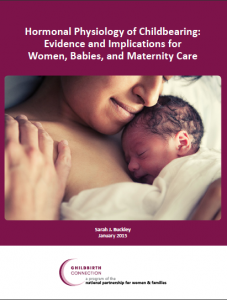
Hormonal Physiology of Childbearing– Sarah’s groundbreaking report

Skin to skin contact- review and summary

Benefits of skin to skin for postpartum depression -study


Filed Under: Blog

In Praise of Midwives

November 20, 2017 by Sarah Buckley

Some people change the course of your life. My midwife Christine Shanahan, who passed away last month, changed my life, and the lives of literally thousands of mothers, babies, fathers/partners and families.

I met Chris in Melbourne, where we were living at the time, at our friend Sandy’s first labour and birth . Like all births (and babies), it had its own unique character. Sandy had five older brothers, and one of them came to support her in labour. Very willing, but a little unsure of his role at a homebirth, he ended up mowing the lawns—and formidably protecting the space at the same time.

Through the labour, as we wrung many soothing hot towels together, I was reassured by Chris’ calm demeanour and gentle presence. Both my partner Nicholas and I were fresh from our training in family practice (GP)  obstetrics, so that we watched Chris’s unobtrusive, careful work with professional eyes as well. Sandy birthed her baby beautifully in the water, and we later witnessed Chris’s wonderful postpartum care for the new family.

When we came to select a midwife for our first baby (and intended homebirth), it was a very easy decision. We also engaged experienced homebirth GP Dr Peter Lucas just in case our baby needed medical care. (Possible emergencies were at the top of our minds after our hospital training.) We also had a second midwife, along with four possible support people, including my sister coming over from New Zealand.

As it turned out, I gave birth with just Nicholas, myself and Chris, who walked in as I was starting to push. I remember vividly the relief and safety I felt in that moment, as I looked in her eyes. Peter arrived just as Emma was emerging, posterior and 5lb 1oz (2250g) at birth. We were immensely blessed that Chris and Peter trusted and supported us to care for our small, ahead-of-schedule baby at home.

Amongst the postpartum visits and stellar care, we learned that Chris, who had been adopted, had recently met her birth mother. She told me that she thought her passion for keeping mothers and babies together came from her own early experiences. Somehow our journeys seemed parallel at the time, forging new family ties. She offered to ask another new mama for donor milk if Emma needed it, and she was sweet and open with our preference to “see how we go” with my milk supply, which came through soon after.

Through two more pregnancies, and the beautiful births of Zoe and then Jacob, I spent many hours with Chris. She was always generous with her time, addressing our questions and concerns with wisdom and knowledge. Sometimes our pregnancy visits lasted 2 hours. We judged her care to be vastly superior, compared to any hospital or medical care that we had seen. I was also very aware, from my hospital training and experience, of the extra ease and pleasure that I gained through birthing at home with Chris’s support. This included Zoe’s posterior labour and birth, and Jacob’s way-past-due-date arrival, and the lotus births of both babies.

After this we moved north, so we missed having Chris’s TLC with our fourth baby Maia. We kept in touch over the years, and I sent her my Gentle Birth, Gentle Mothering books, with deep appreciation for her central influence in my family, life, and work. Last time I asked, she told me she had caught more than 1500 babies, including babies born at home and in hospital. She was always on my Christmas card list: from my perspective Chris was family. We shared her delight with the birth of her grandson, and the nourishment of her family. Chris had some health problems over her life. She died peacefully surrounded by her family.

I’m writing this to honour not just Chris, but all midwives, and to sing the praises of “continuity of midwifery care.” Having one midwife giving care from pregnancy through to birth and baby is not just a great experience. According to  the Cochrane collaboration, which summarises the best medical evidence,  continuity of midwifery care reduces the chance of early pregnancy loss, as well as lessening women’s need for pain relief in labour, and enhancing her satisfaction with the birth, with no extra risks for mother or baby. And a recent study from here in Brisbane showed that midwifery care can also buffer against pregnancy stress.

According to the World Health Organisation, midwives are skilled at “optimizing normal biological, psychological, social and cultural processes of reproduction and early life, timely prevention and management of complications, consultation with and referral to other services, respecting women’s individual circumstances and views, and working in partnership with women to strengthen women’s own capabilities to care for themselves and their families”.

And midwifery care is not just beneficial for individuals. According to a recent series on midwifery care in the prestigious Lancet journal, “Midwifery is a vital solution to the challenges of providing high-quality maternal and newborn care for all women and newborn infants in all countries.”

Whether you are planning a hospital, birth centre, or home  birth, remember that midwifery care is the gold standard.

Blessed be the midwives

More information

Emma’s Birth: Sweet and Oceanic. In Gentle Birth, Gentle Mothering and First edition (2005) ebook

Kildea S et al. 2017 Continuity of midwifery carer moderates the effects of prenatal maternal stress on postnatal maternal wellbeing: the Queensland flood study.

Renfrew M et al 2014 (Lancet) Midwifery and quality care: findings from a new evidence-informed framework for maternal and newborn care

Sandall et al.  2024 (Cochrane Database Systematic Review) Midwife-led continuity models versus other models of care for childbearing women.

World Health Organisation: Midwives are essential

Filed Under: Blog

Epidurals in Labour (Part 2)

May 25, 2017 by Sarah Buckley

What do you know about epidurals and their risk and benefits?  In this blog (Part 2), Dr Buckley explores the impacts of epidural on the hormones of labour and birth , and what this might mean for mothers and babies in the short and longer-terms. (You can read Part 1 here)

Like all interventions in labour and birth, epidurals have benefits and risks for mothers and babies. Part 1 explores how epidurals work; the role of stress in labour (its not all bad!); epidural side-effects, including impacts on oxytocin systems; and why epidurals usually slow labour.

In this Part 2, we will look in more depth at the hormones, and what research tells us about epidural impacts, including on the longer-term hormonal processes of breastfeeding and bonding.

These FAQs are intended to help you to balance the benefits and risks of epidurals for yourself and your own unique situation, so that you can make the choices that are right for you, your baby and your family.

How do epidurals impact oxytocin in labour?

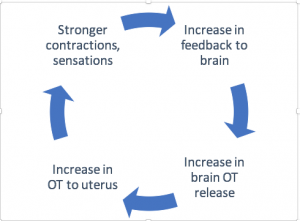
As described in detail in Part 1, the sensations of labour provide feedback to the brain to increase oxytocin release. This leads to stronger contractions, more sensations, and more oxytocin release. This positive feedback cycle drives labour progress, as shown in the diagram.

Labour progress usually slows or stops after epidural administration because of the lack of sensation and sensory feedback to the brain. This also reduces oxytocin release within the brain

Why is oxytocin doing in the labouring mother’s brain, anyway?

While oxytocin is most famous in childbirth for causing the contractions of labour, it has many other beneficial effects that depend on its release in the brain. Oxytocin has pain-relieving and stress-reducing effects that are welcome in labour. Oxytocin also activates brain pleasure and reward centres that contribute to post-birth euphoria.

Reward centre activation  happens for all mammals as mothers meet their newborns for the first time. This imprints pleasure in relation to infant contact, and ensures that mothers will be rewarded and motivated to give the dedicated care that all mammalian newborns require. This is why dog, cow, or elephant mamas will devotedly care for their babies (and butt or bite you if you try to interfere!) without ever going to a prenatal class or reading a book.

Natural birth pioneer Michel Odent calls this phase,”The beginning of a great love affair.” The oxytocin peaks in the brain from release during labour and birth, and heightened further by first contact, ensure that mother and baby will have the best first date ever! (See more in my Ecstatic Birth ebook here).

How does oxytocin help with breastfeeding?

Oxytocin is also the hormone that causes the let-down, or milk-ejection reflex during breastfeeding. Stimulation of the nursing mother’s nipple (or sometimes just the thought of her baby) causes a surge of oxytocin to be released from her brain into her body. This activates milk ducts that push milk to the suckling baby. In addition, nursing-related pulses of oxytocin stimulate the release of prolactin, which promotes milk production in the longer-term.

At the same time, oxytocin released into the mother’s brain reinforces pleasure and reward, so that she will enjoy contact with, and breastfeeding, her baby . The baby also receives oxytocin with suckling, with digesting, and through the milk, so that both will benefit from oxytocin’s relaxing, “calm and connection,” and “hormone of love” effects.

Could epidurals affect breastfeeding?

There are several ways that epidurals could affect breastfeeding. First, the numbing local anaesthetic and sedating opioid drugs used in epidurals all cross into the baby’s body. These drugs have been found in newborn urine even 1-3 days after birth. Opioid drugs such as fentanyl could affect the newborns ability to establish breastfeeding, as some studies have found.

The negative effects of epidurals on maternal oxytocin could also affect breastfeeding. Studies have found disruptions to oxytocin release during early breastfeeding among women exposed to epidurals, along with synthetic oxytocin, in labour. This could also reduce prolactin release, and disrupt future milk production.

Possible longer-term effects of epidurals on breastfeeding have not been studied in high-quality research. See below for more about supporting breastfeeding when an epidural is needed.

How does oxytocin help with bonding

As discussed above, oxytocin released into the mother’s brain during labor and birth activates maternal circuits that switch on instinctive mothering. Powerful activation of reward and pleasure centres at this time ensures that the mother finds her offspring pleasurable and rewarding.

In addition, human studies have found that new mothers experience changes in personality following physiologic birth, making them more relaxed and interactive, which also helps with enjoying her baby.

Could epidurals affect bonding?

This area has not been well researched. Some studies have shown impacts such as more negative descriptions of the baby at one month among women exposed to labour epidurals, which might reflect disruption to the activation of reward systems. In addition, the usual postpartum personality changes described above are not seen in women who have had an epidural, which could also make the transition to motherhood more difficult.

Note that these studies do not imply that women who have had epidurals (or other interventions) will love their babies less, or be negatively impacted in their mothering. However, having an epidural may reduce the ‘head start’ that Mother Nature  provides through the peaks of oxytocin and other hormones in physiologic labour and birth. The resulting ‘hormonal gap’ may take some effort to fill.

What can we do to help mothers and babies to fill in these “hormonal gaps”? 

In summary, epidurals can create a hormonal gap for the new mother (and the baby, directly or indirectly) in relation to oxytocin. This could impact the initiation of breastfeeding for mother and/or newborn, and potentially disrupt the pleasure and reward she experiences with her baby.

These hormonal gaps can be filled, but more effort will be needed outside of the biologically ‘sensitive period’ of labour and birth. For example hormone receptor numbers reach peak levels at physiologic labour onset, making hormonal systems maximally sensitive and most easily activated through to the early postpartum period.

Human studies show maximal oxytocin receptor numbers in the uterus, and animal studies (impossible to do on women) show maximal brain and mammary gland receptors for oxytocin and prolactin.

Filling in hormonal gaps means supporting activities that stimulate hormonal release for mother and baby. The most powerful of these are skin-to-skin contact and breastfeeding.

Practically, this would mean promoting early and ongoing skin to skin contact, with liberal opportunities for newborn-initiated breastfeeding, along with extra breastfeeding help if needed, eg lactation consultant support. These practices feature prominently in epidural studies that show good outcomes for breastfeeding.

Want to know more?

Ecstatic Birth: Nature’s Hormonal Blueprint for Labour (free ebook)

Hormonal Physiology of Childbearing Report, see especially section 3.2.5

Epidurals and breastfeeding review and study on fentanyl 

Impacts of epidurals on breastfeeding hormones and personality changes

Epidural drugs in the newborn e.g. here and here

My whole-day Undisturbed Birth workshop on DVD  You can attend my acclaimed workshop in the comfort of your own home!

  • Learn all about the ecstatic hormones of labour and birth, and how to make the most of them
  • Find out how maternity-care interventions including epidurals can impact these delicate hormonal systems.
  • Discover the hormonal magic of the hour after birth, and how to give your newborn the best start with cord clamping.

This DVD workshop is suitable for interested parents as well as birth professionals, with free  postage worldwide.


Filed Under: Blog

Epidurals in Labour (Part 1)

March 28, 2017 by Sarah Buckley


What do you know about epidurals and their risk and benefits?  In this blog (Part 1) , Dr Buckley explores the impacts of epidural on oxytocin and the flow of labour, and what this might mean for mothers and babies.

Epidurals are a very effective method of pain relief for labouring women, and are often encouraged by caregivers, even before labour begins.

Like all interventions, epidurals have benefits and risks for mothers and babies. Possible risks include the potential to disrupt the processes of labour for mother and baby. There are also unanswered questions about possible impacts through to motherhood, including effects on breastfeeding and bonding.

These FAQs will help you to balance the benefits and risks of epidurals for yourself and your own unique situation, so that you can make the choices that are right for you, your baby and your family.

What is an epidural?

Epidural analgesia involves an injection into the lower back that pierces the outer coverings (”epi-dura”) of the spinal cord. Drugs are injected close to the nerves as they come out from the spinal cord. Usually this involves a “local anaesthetic” (LA) drug such as bupivacaine, along with an “opiate” drug (related to morphine, pethidine/meperidine etc) such as Fentanyl. Epidurals are used in many types of surgery and procedures, and also sometimes administered to relieve pain outside of childbirth.

How do epidurals work?

Just like a dental anaesthetic, LA drugs block the sensory nerves, causing numbness, and also inevitably block the motor nerves, giving some degree of paralysis. Opiate drugs are added to an epidural to increase the effectiveness of the LA, so that there will be good pain relief with less motor block.

What are the benefits of epidurals?

Obviously, the main benefit of an epidural is the very effective pain relief that most women experience. Because of this effective analgesia, epidurals also reduce stress, and stress hormones, in labour. This can be beneficial when women are experiencing very high levels of stress and pain, which can slow labour progress.

Is labour stress harmful?

It is important to realise that some degree of stress is inevitable in labour, and actually beneficial for mother and baby. For example, high levels of the stress hormone cortisol contribute to a new mother’s euphoria, and help with bonding with her newborn. For the baby, the “stress of being born” switches on biologic processes that help with breathing at birth, among other adaptations. (See below for references)

Are epidurals good if I need a caesarean?

Epidurals also allow you to be awake and alert, but pain free, when procedures such as caesareans are needed. You will be able to see and hold your baby soon afterwards. In this situation, you and your baby will also be exposed to lower levels of drugs than a “general anaesthetic.”

What are the side-effects of epidurals?

Many of the side-effects of epidurals are due to effects on your  birthing hormones. These are the calming, pain relieving, and stress-reducing chemicals that your body naturally produces to make labour as easy, safe and rewarding as possible. (See my Ecstatic Birth ebook for more info).

How do hormones help in labour?

The hormone oxytocin is particularly important because it causes the uterine contractions that drive labour and birth.

During a natural (physiological) labour and birth, the sensations of uterine contractions are transmitted to the labouring woman’s brain, and drive the oxytocin “positive feedback cycle” (Ferguson reflex). Within this cycle, uterine sensations trigger oxytocin release, more contractions, more sensations, and more oxytocin release. This strengthens labour and also helps the baby to be born quickly and easily.

As the diagram shows, this positive feedback cycle also increases oxytocin release into the brain, where it has calming and pain relieving effects. (Very welcome in labour!)  Oxytocin also turns on reward and pleasure centres in the brain during labour and birth, in preparation for mothering. (More about this in part 2)

Why do epidurals slow labour?

With an epidural, your labour sensations will usually be completely abolished. This means that there is no sensation to drive this oxytocin feedback cycle, and your oxytocin levels will decline.

This explains why labour usually slows, and sometimes even stops, in the hours following epidural administration. You will probably require an infusion of synthetic oxytocin (Pitocin, Syntocinon) to compensate for the loss of your own oxytocin, and to strengthen labour again.

More epidural resources

Epidural FAQs part 2.

What are the consequences of missing the oxytocin peaks for mothers, babies, breastfeeding and bonding? How can we fill in the hormone gaps when epidurals are needed? Part 2 Coming soon!

Epidurals: Risks and Concerns for Mothers and Babies Chapter from Gentle Birth, Gentle Mothering (2005)

Undisturbed Birth DVD Dr Buckley’s workshop on DVD. Discover the “ecstatic hormones” of labour and birth and the impacts of interventions, including epidurals

Hormonal Physiology of Childbearing Dr Buckley’s in-depth report (2015) has all the scientific detail and studies. See particularly sections 3.2.5, 4.2.5, 5.2.6 and 6.2.5 .

Filed Under: Blog

  • « Go to Previous Page
  • Page 1
  • Page 2
  • Page 3
  • Page 4
  • Go to Next Page »

Primary Sidebar

Reap the lifelong benefits of a Transformational Birth. find out more.

Sarah Buckley's Online Store
All of my books, DVD's and more!

Recommended Resource

Happy Healthy Child DVDs

Happy Healthy Child Video

Happy Healthy Child- the Ultimate Childbirth Course! Parenting is changing-- have you noticed? The old paradigms from our parents' generation are transforming. Our new values, built around love and … Read More... about Happy Healthy Child Video

Footer

Sarah’s Qualifications

Sarah is a Medical Doctor, with an M.B Ch.B from University of Otago, New Zealand, equivalent to MB BS (Australia) and MD(US). She also holds a Diploma of Obstetrics (University of Auckland) and a Diploma of Family Planning (Family Planning Victoria).

Reap the lifelong benefits of a Transformational Birth. find out more.

On this Site

  • Privacy and Security
  • About Sarah
  • Sarah’s Schedule
  • Books
  • Membership
  • Shop
  • Contact Dr Buckley

© 2025 · Sarah Buckley · Built by 3E Innovative

Ecstatic BirthsDiscover the secrets of a Gentle Natural Birth!

Receive Dr Buckley’s Ten Tips for Gentle Natural Birth and sign up to her newsletter (No spam ever!)

Read the Gentle Natural Birth Privacy Policy