• Skip to primary navigation
  • Skip to main content
  • Skip to primary sidebar
  • Skip to footer

Dr Sarah Buckley

  • Home
  • Books
    • Book Reviews
  • Articles
    • Attachment Parenting: An Introduction
    • Pain in Labour: Your hormones are your helpers
    • Epidurals: risks and concerns for mother and baby
    • Ultrasound Scans- Cause for Concern
    • Leaving Well Alone: A Natural Approach to the Third Stage of labour
    • Getting a Good Night’s Sleep: Another Perspective
    • Mothering, Mindfulness and a Baby’s Bottom: An Introduction to Elimination Communication
    • Ten tips for safe sleeping
    • Lotus birth – a Ritual for our Times
    • Giving Birth at Home
    • Healing Birth, Healing the Earth
    • Maia’s Birth- a family celebration
  • Blog
  • About Sarah
    • More of Sarah
    • Sarah’s Schedule
    • Frequently Asked Questions
    • Contact Dr Buckley
  • Shop
  • Sign up to Sarah’s Newsletter

Professional Development

Hormonal Physiology, Oxytocin and More

February 11, 2022 by Sarah Buckley

When we interact with our babiesSince the publication of her 2015 report Hormonal Physiology of Childbearing (more info and links here) Dr Buckley has continued to research and write about the hormones of physiological labour and the impacts of interventions.

She is currently a PhD candidate at the University of Queensland (Brisbane, Australia) studying oxytocin in childbearing.

This page lists the publications Sarah has co-authored, with links and descriptions. You can receive information about new publications by signing up to Sarah’s newsletters. 

Maternal and newborn plasma oxytocin levels in response to maternal synthetic oxytocin administration during labour, birth and postpartum – a systematic review with implications for the function of the oxytocinergic system. Buckley S, Uvnäs-Moberg K, Pajalic Z, Luegmair K, Ekström-Bergström A, Dencker A,Massarotti, C. Kotlovska, A Callaway, L Morano S, Olza Fernandez I, Meier-Magistretti C. BMC Pregnancy Childbirth. 2023;23(1):137. Full text here 

Maternal plasma levels of oxytocin during physiological childbirth – a systematic review with implications for uterine contractions and central actions of oxytocin. Uvnas-Moberg, K., A. Ekstrom-Bergstrom, M. Berg, S. Buckley, Z. Pajalic, E. Hadjigeorgiou, A. Kotlowska, L. Lengler, B. Kielbratowska, F. Leon-Larios, C. M. Magistretti, S. Downe, B. Lindstrom and A. Dencker (2019).  BMC Pregnancy Childbirth 19(1): 285  Full text here

Maternal plasma levels of oxytocin during breastfeeding-A systematic review. Uvnäs Moberg, K., A. Ekström-Bergström, S. Buckley, C. Massarotti, Z. Pajalic, K. Luegmair, A. Kotlowska, L. Lengler, I. Olza, S. Grylka-Baeschlin, P. Leahy-Warren, E. Hadjigeorgiu, S. Villarmea and A. Dencker (2020). PLoS One 15(8): e0235806. More info and full text links here

Birth as a neuro-psycho-social event: An integrative model of maternal experiences and their relation to neurohormonal events during childbirth. Olza, I., K. Uvnas-Moberg, A. Ekström-Bergström, P. Leahy-Warren, S. I. Karlsdottir, M. Nieuwenhuijze, S. Villarmea, E. Hadjigeorgiou, M. Kazmierczak, A. Spyridou and S. Buckley (2020) PLoS One 15(7): e0230992. More info and full text links here  

Nature and consequences of oxytocin and other neurohormones during the perinatal period.Buckley S, Uvnäs Moberg K Chapter in: Downe S, Byron S, editors. Squaring the Circle: Normal birth research, theory and practice in a technological age. London: Pinter and Martin; 2019. p. 19-31 More info and links to purchase this book here 

The initiation of labour at term gestation: Physiology and Practice implications. Hundley, V., S. Downe and S. J. Buckley (2020). Best Pract Res Clin Obstet Gynaecol Aug; 67:4-18  More info (This article is only available via subscription or payment

Physiologic Basis of Pain in Labour and Delivery: An Evidence-Based Approach to its Management. Practice Guideline No. 355 Bonapace, J., G. P. Gagne, N. Chaillet, R. Gagnon, E. Hebert and S. Buckley (2018). J Obstet Gynaecol Can 40(2): 2 DOI: 10.1016/j.jogc.2017.08.003  More info (This article is only available via subscription or payment

You can find more of Sarah’s science and wisdom in her  blogs  podcast interviews and books and DVDs

Filed Under: Blog, Childbirth, HPOC, Parenting, Pregnancy, Professional Development

What’s so Great about Hormonal Physiology?

May 5, 2015 by Sarah Buckley

When we interact with our babiesHormonal physiology describes the healthy functioning of our hormonal systems. My new report Hormonal Physiology of Childbearing provides scientific evidence and detail about these processes in pregnancy, labour, birth and postpartum, including the impacts of common maternity-care interventions on these systems.

Our childbearing hormones are critical to actually making labour and birth happen! Beginning in the final weeks and days – and likely hours– before the natural (physiological) onset of labour, our hormone systems prepare us for an efficient labour and birth, help with labour pain and stress; ensure a safe passage for our babies and, after it is all over, give us feelings of reward and pleasure as we meet our newborns for the first time.

But the benefits of physiologic childbearing – by which I mean, “childbearing conforming to healthy biologic processes”- don’t end with that after-birth glow.  The hormones that make birth happen also prepare us for breastfeeding, with these preparations beginning even before labour starts. In addition, our hormonal physiology, including the hormones oxytocin and prolactin, continues to support milk production and release right through lactation. Oxytocin and prolactin are even present in breastmilk, bestowing calming, connecting effects on our babies as they suckle.

Another critical finding from the report is the important role of these hormones for bonding and attachment. In all mammals – those species that suckle their young—hormonal physiology supports and rewards the dedicated care that mammalian mamas give to their newborns. In fact, all of the hormone systems that are discussed in the report- oxytocin, beta-endorphins, norepinephrine and prolactin- are involved in maternal-infant attachment, which is a critical process to ensure the best care and safest upbringing, which helps the species to survive.

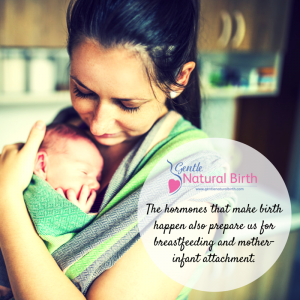
These hormonal supports are also active in human mothers. When we interact with our babies- hold, carry, touch, talk to, breastfeed- we are rewarded with the release of oxytocin, beta-endorphins and prolactin, which give us pleasure by activating the dopamine-related pleasure centres in our brains. The more pleasure we get from interacting, the more we want to be with our babies, which benefits their health and development.

These pleasure and reward systems can be powerfully activated in women, as in other mammals, by the birth-related peaks of oxytocin and other hormones, giving us the head-start that maximizes pleasure and dedicated infant care into the future. (See my discussion of “biologic bonding” in the report.) If we miss these peaks, we may need some extra assistance to get these systems flowing. Lots of touch, carrying, contact and nursing our babies will activate these systems, and benefit our babies as well.

To find out more, and to see the scientific research that describes these processes, please look at the whole report, which is available in full for free online here . Sections 3.1.4 , 4.1.4 and 5.1.4 describe hormonal physiology after birth and you can also search the document for any words of interest.

We also have some fabulous infographics for women and care providers and a booklet describing hormonal physiology for parents.

Wishing you all power peace and pleasure for yourselves and in your work with childbearing.

Filed Under: Blog, Childbirth, HPOC, Parenting, Pregnancy, Professional Development

Hormonal Physiology of Childbirth: How to eat an elephant
February 18, 2015 by Sarah Buckley

“This report, prepared by Dr. Sarah Buckley in collaboration with Childbirth Connection Programs at the National Partnership for Women & Families, will be retrospectively evaluated as one of the most revolutionary and influential publications on maternity and newborn care ever issued.” (Foreword, p.v)

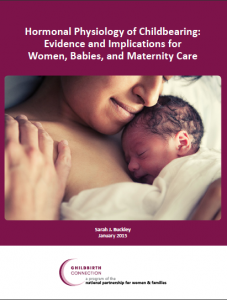
The Hormonal Physiology of Childbearing report

Please open!

I hope that you have had the chance to look at my report, Hormonal Physiology of Childbearing, available in full for free  here. 

It is a very long and in-depth report- what we refer to as “the Mother Ship” in that we are anticipating that it will be used as a source document for many other publications, including ones that you might write!

As with metaphorically, “eating an elephant”, I suggest that you approach it in small bites, and look for the areas that interest you. Because this is a pdf file, you can use the search function to find any topic.

Tasty topics!

Here are some of my favourite topics and sections.

  • What preparations do mothers and babies make, even before labour begins, to ensure a safe passage? (Chapter 2.1)
  • How might foreshortening these processes with induction or pre labour caesarean impact mothers and babies? (Ch 2.2)
  • How does oxytocin, hormone of love, benefit mothers and babies in childbearing?(Ch 3.1)
  • Could the use of synthetic oxytocin impact the oxytocin systems of mothers and babies in the short and even longer-terms? (Ch 3.2)
  • Can events at birth such as induction and cesarean, impact longer-term health and wellbeing? (Ch 1)

General recommendations

These are my general suggestions for approaching this document.

For parents

I suggest you first check out the

  •  Mother-friendly infographic 

  •  Consumer booklet

  • En Espagnol

If you want more juicy details then read

  • The abstract (page i)

  • The Executive Summary (ES) of the Introduction (p x-xi)

If you want even more, read the rest of the ES and then the Introduction (Chapter 1, p1-13)

Birth professionals

I recommend reading

  • The abstract (page i)

  • Foreword (p v-vi)

  • Executive summary

  • Introduction (chapter 1).

Chapter 2 details the amazing process that proceed physiologic (spontaneous) labour onset, including how amazing our bodies are.

If you are an oxytocin lover, you’ll want to dive right into Chapter 3. Take it from there….

Again, the full report and related materials are all free to download here. 

Also, check out the fabulous mother-friendly infographic and  booklet.

NB Readers:  Because the report is a pdf file, you can use the search function to find any topic.

I’d love to get any feedback and questions as we are currently preparing FAQs Please email me at info [at] sarahbuckley.com.

Filed Under: Blog, Childbirth, HPOC, Pregnancy, Professional Development

Hormonal Physiology of Childbearing Report

December 18, 2014 by Sarah Buckley

• How are labour and birth designed to work for mother and baby?
• What processes ensure that both make the safest and easiest transitions from pregnancy to postpartum?
• Are there important preparations before birth that optimise these transitions?
• How does birth impact breastfeeding?
• Might birth also impact maternal-infant attachment and bonding?
• Do the processes of birth have longer-term implications for mother and baby?

Since 2001 I have been exploring these and other questions about the hormones of labor and birth in my articles, books and talks. In 2002, Mothering magazine published my article Ecstatic Birth, Nature’s Hormonal Blueprint for Labor. This very popular article has found its way into many curriculums, including doula trainings and childbirth classes all over the world. It has also been translated into Spanish as well as Italian and German. The updated article is  available as a free ebook on my website for  subscribers.

Through reading many more scientific and medical studies, I have seen clearly that these hormonal processes are hard-wired into the bodies of mothers and babies as our biological blueprint. The “ecstatic hormones” released during labour, and peaking in the moments after birth, not only give pleasure and reward, but also optimise safety, ease and pleasure for mother and baby.

It has been my pleasure and privilege to work with Carol Sakala from Childbirth Connection (now a core program of the National Partnership for Women & Families) to deepen this understanding of the hormones of labour and birth even further with my report, Hormonal Physiology of Childbearing.

Carol and I had the pleasure of meeting when I was in in New York in September, which was thrilling after working together on Skype for so long- see the picture of us with the wonderful Elan McAllister, founder of Choices in Childbirth who hosted me in NYC.

Carol Sakala Elan McAllister and Sarah Buckley
Childbirth Connection’s Carol Sakala, Choices in Childbirth Founder Elan McAllister, with Sarah Buckley in New York

We are readying my new report, Hormonal Physiology of Childbearing, for publication in January by the National Partnership for Women & Families. Read more here)

The report explores the childbearing hormones for mother and baby in great depth and detail. This extensive report has over 1000 references to scientific studies and includes an executive summary within its 200+ pages.

What is especially exciting is the abundance of recent articles and studies that support the hormonal physiology perspective, and the advantages of “physiologic birth”, which we define as “childbearing conforming to healthy biologic processes.”These publications include new understandings of the critical roles of oxytocin in parenting and in lifelong wellbeing.

Many aspects of maternity care, and maternity-care interventions, can interfere with this hormonal flow. Sometimes care practices and interventions are necessary for the safety of mother and/or baby. Understanding the hormonal impacts is the first step to helping mothers and babies to optimise hormonal physiology. From the Hormonal Physiology of Childbearing perspective, every mother and baby is likely to benefit from additional support for physiologic childbearing, as far as safely possible, including when interventions are used.

The report is now available in full online for free, along with separate files of abstract, executive summary, recommendations and related items.

.

Filed Under: Blog, Childbirth, Pregnancy, Professional Development Tagged With: childbirth, physiology

Primary Sidebar

Reap the lifelong benefits of a Transformational Birth. find out more.

Sarah Buckley's Online Store
All of my books, DVD's and more!

Recommended Resource

Happy Healthy Child DVDs

Happy Healthy Child Video

Happy Healthy Child- the Ultimate Childbirth Course! Parenting is changing-- have you noticed? The old paradigms from our parents' generation are transforming. Our new values, built around love and … Read More... about Happy Healthy Child Video

Footer

Sarah’s Qualifications

Sarah is a Medical Doctor, with an M.B Ch.B from University of Otago, New Zealand, equivalent to MB BS (Australia) and MD(US). She also holds a Diploma of Obstetrics (University of Auckland) and a Diploma of Family Planning (Family Planning Victoria).

Reap the lifelong benefits of a Transformational Birth. find out more.

On this Site

  • Privacy and Security
  • About Sarah
  • Sarah’s Schedule
  • Books
  • Membership
  • Shop
  • Contact Dr Buckley

© 2025 · Sarah Buckley · Built by 3E Innovative

Ecstatic BirthsDiscover the secrets of a Gentle Natural Birth!

Receive Dr Buckley’s Ten Tips for Gentle Natural Birth and sign up to her newsletter (No spam ever!)

Read the Gentle Natural Birth Privacy Policy